
Unraveling the Complexities of Microcystis aeruginosa Species Growth: The Role of Cell Density and Phosphorus
DOI:
https://doi.org/10.62497/irjpab.249Keywords:
Microcystis aeruginosa, cyanobacteria, harmful algal blooms, phosphorus, dissolved organic phosphorus, dissolved inorganic phosphorus, cell density, alkaline phosphatase activity, freshwater ecosystemsAbstract
Introduction: Microcystis aeruginosa (M. aeruginosa) is a common cyanobacterial species capable of forming harmful algal blooms (HABs), which can negatively affect freshwater ecosystems and water quality. The growth and bloom-forming potential of M. aeruginosa are influenced by environmental factors, particularly phosphorus availability and initial cell density. However, the response of M. aeruginosa to different phosphorus sources at varying cell densities has not been sufficiently investigated.
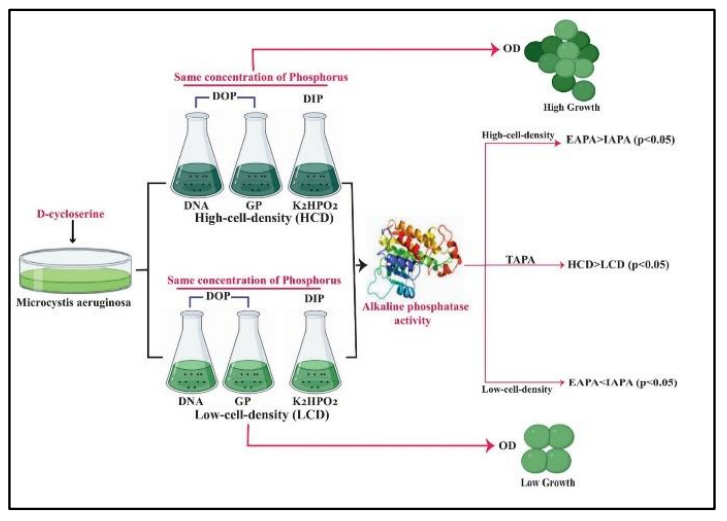
Objective: This study aimed to investigate the effects of high (2 × 10⁵ cells mL⁻¹) and low (2 × 10⁴ cells mL⁻¹) initial cell densities and different organic and inorganic phosphorus sources on the growth and alkaline phosphatase activity of M. aeruginosa under laboratory conditions.
Materials and Methods: Laboratory experiments were conducted using M. aeruginosa cultures maintained at two initial cell densities: high (2 × 10⁵ cells mL⁻¹) and low (2 × 10⁴ cells mL⁻¹). The cultures were exposed to media containing dissolved organic phosphorus (DOP), dissolved inorganic phosphorus (DIP), and a phosphorus-free control. Changes in cell abundance and growth were monitored throughout the experimental period. In addition, intracellular alkaline phosphatase activity (IAPA) and extracellular alkaline phosphatase activity (EAPA) were assessed to evaluate the enzymatic response associated with phosphorus acquisition.
Results: The results demonstrated that initial cell density significantly influenced the growth of M. aeruginosa. Cultures with higher initial cell densities exhibited greater growth rates, with growth increasing by 108.41% compared with cultures established at lower cell densities. A similar relationship between M. aeruginosa growth and phosphorus availability was observed at both initial cell densities. Cell abundance was generally higher in DOP- and DIP-containing media than in the phosphorus-free control. The highest recorded cell abundance under the experimental conditions was 0.755 ± 0.005 × 10⁶ cells mL⁻¹. Other recorded values were 0.320 ± 0.005 × 10⁶ cells mL⁻¹ for DOP, 0.270 ± 0.005 × 10⁶ cells mL⁻¹ for DIP, and 0.269 ± 0.005 × 10⁶ cells mL⁻¹ for the control, respectively. The findings also indicated that M. aeruginosa has the potential to develop into algal blooms even at a relatively low initial cell density of 2 × 10⁴ cells mL⁻¹. Furthermore, IAPA was 25% higher than EAPA, indicating an important role of intracellular phosphorus-acquisition mechanisms.
Conclusion: The study demonstrates that both initial cell density and phosphorus availability are important factors regulating the growth of M. aeruginosa. The presence of organic and inorganic phosphorus enhanced cyanobacterial abundance compared with phosphorus-free conditions. The ability of M. aeruginosa to grow and potentially form blooms even at low initial cell densities highlights the importance of monitoring phosphorus availability and cyanobacterial populations in freshwater ecosystems. These findings may contribute to the development of effective strategies for predicting and controlling harmful algal blooms.
Additional Files
Published
Issue
Section
License

This work is licensed under a Creative Commons Attribution-NonCommercial 4.0 International License.