
Evaluating the Impact of Female-Only Teaching Staff in Government Primary Schools on Enrollment, Retention, and Learning Outcomes
DOI:
https://doi.org/10.62497/irjed.193Keywords:
education, primary education, enrollment, retention, learning results, propensity score matching, gender equity, female instructor, gender, educational quality, female teachersAbstract
Introduction: Even in developing countries, gender disparities in elementary education access and outcomes remain a persistent challenge. Female teachers are widely believed to create safer, more supportive learning environments, particularly for young girls, which can positively influence enrollment, retention, and learning outcomes.
Objective: This study assesses the effects of female-only teaching faculty in government primary schools in Peshawar on student enrollment, retention, and learning outcomes.
Material and Methods: A quasi-experimental, longitudinal design was employed, comparing student outcomes at the start and end of 2023 across 40 government primary schools. The sample included approximately 20–25 students per school in Grades 1–5. Propensity Score Matching (PSM) was used to ensure comparability across grades and school characteristics, while Difference-in-Differences (DiD) regression models with school fixed effects and clustered standard errors were applied to estimate the causal effects of female-only teaching staff on student outcomes, controlling for school-level variables such as pupil–teacher ratio, teacher qualifications, infrastructure, and socio-economic context. Supplementary qualitative data from interviews with teachers and focus group discussions with parents contextualized the quantitative findings.
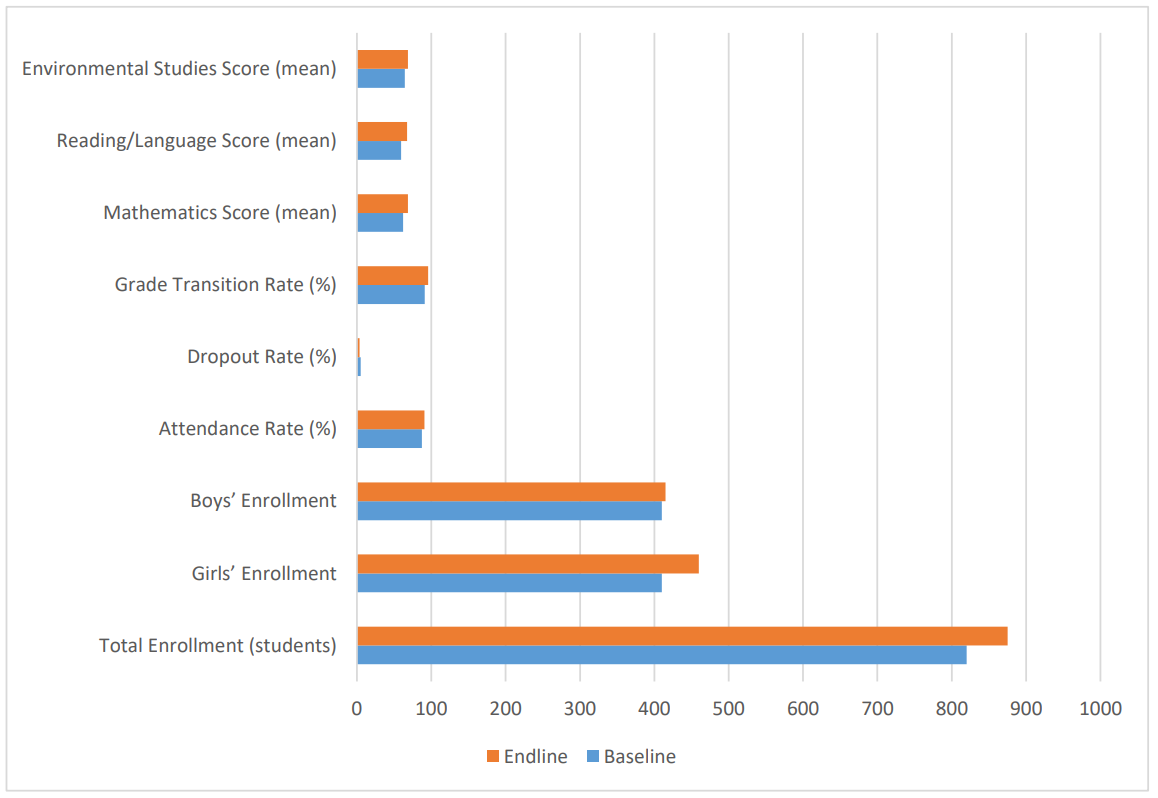
Results: Female-only staffed schools demonstrated significant improvements in enrollment, particularly for girls, alongside higher attendance rates, lower dropout rates, and increased grade transition rates. Standardized learning assessments showed substantial gains in Mathematics, Reading/Language, and Environmental Studies over the study period. These effects were robust across multiple model specifications and subgroup analyses. The findings suggest that the presence of female teachers enhances academic achievement, engagement, and retention, thereby contributing to overall educational quality and gender equity.
Conclusion: The study provides strong evidence that female-only teaching staff in government primary schools significantly improve student enrollment, retention, grade progression, and learning outcomes, with particularly pronounced benefits for girls. These findings underscore the policy relevance of female teacher representation. Practically, education authorities should prioritize the recruitment, training, and equitable deployment of qualified female teachers, especially in underserved and rural areas, while ensuring supportive working conditions and retention incentives. Future research should explore the long-term academic and socio-economic impacts of female teacher representation and investigate contextual factors that may enhance or moderate these effects to inform more targeted and sustainable education policies.
References
Ahmed, S. Z., Sultan, S., Kousar, M., Basit, H. A., Zaid, R., & Bano, S. (2022). Effectiveness of teacher’s centered approach on student’s learning at university level. Journal of Positive School Psychology, 6(10), 4157–4166. https://journalppw.com/index.php/jpsp/article/view/13038/8449
Ahmed, S., & Kazmi, H. H. (2020). Teacher Educators' Attitude towards the Pedagogical Use of ICTs: A Study from Karachi, Pakistan. Journal of Education and Educational Development, 7(2), 369-386. https://doi.org/10.22555/joeed.v7i2.67
Ali, S. S. (2019). Problem based learning: A student-centered approach. English language teaching, 12(5), 73-78. https://www.researchgate.net/publication/332352523_Problem_Based_Learning_A_Student-Centered_Approach
Andrabi, T., Das, J., & Khwaja, A. (2005). Private schooling: Limits and possibilities. Processed. The World Bank, Washington, DC. https://www.researchgate.net/publication/23723371_A_Dime_a_Day_The_Possibilities_and_Limits_of_Private_Schooling_in_Pakistan
Anvar, M., Khademi, S., Meshkibaf, M. H., Fereydouni, Z., & Ebrahimi, A. (2006). The comparison between teacher centered and student centered educational methods. Journal of Medical Education for Future Demands, 9(1), e105285. https://doi.org/10.22037/jme.v9i1.735
Anwer, F. (2019). Activity-based teaching, student motivation and academic achievement. Journal of Education and Educational Development, 6(1), 154-170. https://www.researchgate.net/publication/333397973_Activity-Based_Teaching_Student_Motivation_and_Academic_Achievement
Bhattacharya, U. (2022). “I am a parrot”: Literacy ideologies and rote learning. Journal of Literacy Research, 54(1), 32–55. https://doi.org/10.1177/1086296X221098065
Freeman, S., Eddy, S. L., McDonough, M., Smith, M. K., Okoroafor, N., Jordt, H., & Wenderoth, M. P. (2014). Active learning increases student performance in science, engineering, and mathematics. Proceedings of the National Academy of Sciences, 111(23), 8410–8415. https://doi.org/10.1073/pnas.1319030111
Gillani, D. (2022). Teacher and student centered learning: A philosophical investigation. Pakistan Languages and Humanities Review, 6(3), 457–468. https://doi.org/10.47205/plhr.2022(6-IV)54
Hussain, S. (2021). Quality of education in public and Danish schools at secondary level. International Research Journal of Education and Innovation, 2(2), 160-169. https://doi.org/10.53575/irjei.17-v2.2(21)160-169
Ikram, M., Qureshi, S., & Ahmed, S. (2023). Education quality and student satisfaction nexus using instructional materials, support, classroom facilities and equipment: Evidence from Pakistani private higher education institutes. Frontiers in Education, 8, 1140971. https://doi.org/10.3389/feduc.2023.1140971
Islam, M. S., Hasan, K., & Sultana, S. (2021). English language assessment in Bangladesh: Principles, practices, and problems. Language Testing in Asia, 11(1), 1–21. https://doi.org/10.1186/s40468-020-00116-z
Minaz, M., Tabassum, R., & Ahmad, A. (2018). Gender wise comparison of flipped classroom strategy on the performance of prospective teachers. Advances in Social Sciences Research Journal, 5(3), 578-588. https://www.researchgate.net/publication/324274767_Gender_Wise_Comparison_of_Flipped_Classroom_Strategy_on_the_Performance_of_Prospective_Teachers
Naz, S., Shah, S. A., & Qayum, A. (2020). Gender differences in motivation and academic achievement: A study of the university students of KP, Pakistan. Global Regional Review, 1(19), 45-56. https://www.researchgate.net/publication/341758004_Gender_Differences_in_Motivation_And_Academic_Achievement_A_Study_Of_the_University_Students_of_KP_Pakistan
Niloy NA. Two Major Challenges in Assessment Processes at Secondary Level in Bangladesh: Rote-memorization and High-stakes Examinations. Student (Bachelor of Education). Institute of Education and Research, University of Dhaka. https://zenodo.org/records/14016110
Orhan, A. (2022). The relationship between critical thinking and academic achievement: A meta-analysis study. Psycho-Educational Research Reviews, 11(1), 283-299. https://doi.org/10.52963/PERR_Biruni_V11.N1.18
Prince, M. (2004). Does active learning work? A review of the research. Journal of Engineering Education, 93(3), 223–231. https://doi.org/10.1002/j.2168-9830.2004.tb00809.x
Rind, I. A., & Malik, A. (2019). The examination trends at the secondary and higher secondary level in Pakistan. Social Sciences & Humanities Open, 1(1), 100002. https://www.researchgate.net/publication/336078513_The_examination_trends_at_the_secondary_and_higher_secondary_level_in_Pakistan
Shah, I. H. (2024). The Impact of Student-Centered Teaching Strategies on Educational Attainment of Econometrics Students. SAGE Open. DOI: https://doi.org/10.1177/21582440241240844
Sharan, Y. (2010). Cooperative learning for academic and social gains: Valued pedagogy, problematic practice. European Journal of Education, 45(2), 300-313. https://www.researchgate.net/publication/230245801_Cooperative_Learning_for_Academic_and_Social_Gains_valued_pedagogy_problematic_practice
Siddiqui, N., & Gorard, S. (2017). Comparing government and private schools in Pakistan: The way forward for universal education. International Journal of Educational Research, 82, 159–169. https://doi.org/10.1016/j.ijer.2017.01.007
Ullah, K., Badshah, S., & Qamar, H. (2018). Impact of teacher’s attitudes on academic achievement of students in mathematics: A quantitative assessment in Peshawar, Pakistan. Liberal Arts and Social Sciences International Journal (LASSIJ), 2(2), 22-28. https://doi.org/10.47264/idea.lassij/2.2.3
Downloads
Published
Issue
Section
License
Copyright (c) 2025 Anfal Mehish, Saba Nawaz (Author)

This work is licensed under a Creative Commons Attribution-NonCommercial 4.0 International License.