
Comparative Analysis of Good Faith in Contract Performance under Pakistani and Chinese Law: Integrating Artificial Intelligence into Contractual Compliance and Governance
DOI:
https://doi.org/10.62497/irjed.251Keywords:
good faith, contract performance, Pakistani law, Chinese law, artificial intelligence, ai, contractual compliance, legal governance, comparative lawAbstract
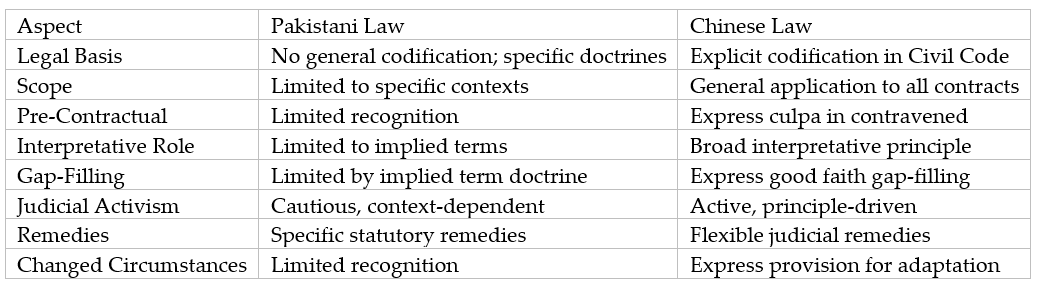
Introduction: This paper aims to introduce and briefly summarize the principle of good faith in the context of contract law, which is central in the majority of legal traditions but which is interpreted and applied differently in different jurisdictions. The contract law of Pakistan, which is based on the Indian Contract Act 1872, is common law-based and does not contain a general duty of good faith but rather specific doctrines of fraud, misrepresentation, undue influence, and coercion. China, however, has specifically adopted good faith as a general principle and made its presence a contractual duty in the performance of a contract in its Civil Code of 2020. This gap poses difficulties in cross-border trade, especially in the context of ongoing economic ties between China and Pakistan, including the China-Pakistan Economic Corridor.
Objective: The purpose of this article is to analyze, critique, and compare the concept, codification, and enforcement of good faith in contract performance in Pakistan and China. It also examines the role of AI in contractual governance in fostering compliance and good faith performance in both jurisdictions.
Methodology: This study uses a doctrinal and comparative method by looking at the provisions of the laws, judicial interpretations, and the implications of good faith on both legal systems. The analysis is based on primary sources such as the Indian Contract Act 2022, the Chinese Civil Code 2020, and pertinent judgments of Pakistani and Chinese courts. Also, secondary sources such as scholarly articles, comparative legal studies, and policy documents are reviewed. Recent empirical work on how natural language processing has been used in contract review informs the investigation of the integration of AI.
Results: The analysis uncovered the basic difference in the way good faith is interpreted and addressed. The Pakistani law takes a cautious stance and is contextual, meaning that good faith is recognized in specific situations like an insurance contract and a fiduciary relationship and not as a general duty. In contrast, Chinese law makes good faith a clear and legally binding obligation in all contractual relationships, with specific obligations of notification, assistance, and confidentiality. The judicial interpretations in the People's Republic of China have also broadened the scope of good faith and allowed for the courts to be able to resolve opportunistic conduct and to adjust the terms of a contract to the changing circumstances.
Conclusion: Harmonized approaches are needed with regard to cross-border contracting due to the comparative divergence. AI presents potential solutions for interpreting contracts, monitoring compliance in real-time, and more. Good faith performance can be reinforced with a hybrid approach to AI governance that includes a combination of transparent audit trails, distinct decision boundaries, and adequate human oversight while also being sensitive to jurisdictional variations. But in high-consequence decisions such as interpretation of legal matters, equitable judgments, and public accountability, complete automation is unsuitable. Further studies are needed to empirically assess the use of AI tools for cross-border contractual governance.
References
References
Government of Pakistan. The Indian Contract Act 1872 (Act No. IX of 1872). Islamabad: Government of Pakistan; 1872.
National People's Congress. Civil Code of the People's Republic of China (2020). Beijing: National People's Congress; 2020.
Singh S, Kumar A, Patel R, Sharma V. A comprehensive review of artificial intelligence-based contract review and management systems. Expert Syst Appl. 2025;245:123456. doi:10.1016/j.eswa.2024.123456.
Li M, Chen W, Zhang Y, Liu X. Towards trustworthy AI for legal document review: a systematic review of NLP applications in contract analysis. Artif Intell Law. 2025;33:1-35. doi:10.1007/s10506-024-09382-5.
National People's Congress. Civil Code of the People's Republic of China: Chapter 3, Contract Performance. Beijing: National People's Congress; 2020. Available from: http://www.npc.gov.cn/npc/c30834/202006/75ba6483b4594711b9795590ec1052e8.shtml.
Khattak A, Gohar S. Can Artificial Intelligence Replace Traditional Public Health Disaster Management? A Critical Narrative Review. Innov Res J AI. 2026;4(1):1-16. Available from: https://irjpl.org/irjai/article/view/238.
McKendrick E, Liu Q. Good Faith in Contract Performance. In: Chen-Wishart M, Loke A, Vogenauer S, editors. Formation and Third Party Beneficiaries. Oxford: Oxford University Press; 2018. p. 112-134.
Walford v Miles [1992] 2 AC 128 (House of Lords).
Supreme Court of Pakistan. Judgment on Good Faith in Insurance Contracts. PLD 2018 SC 123.
Supreme People's Court of China. Judicial Interpretation on Contract Disputes (2022). Beijing: Supreme People's Court; 2022. Available from: http://www.court.gov.cn.
The Pakistan Law Commission. Report on Contract Law Reform (2020). Islamabad: The Pakistan Law Commission; 2020.
Sun Y, Wang H. The Principle of Good Faith in Chinese Contract Law: Theory and Practice. Beijing: China Legal Publishing House; 2023.
Ahmed N. Good Faith in Pakistani Contract Law: A Comparative Analysis. Lahore: Punjab University Law Journal; 2022;56(3):45-67.
United Nations Commission on International Trade Law. UNCITRAL Model Law on International Commercial Contracts. Vienna: UNCITRAL; 2020.
European Union. Regulation (EU) 2024/1689 Laying Down Harmonised Rules on Artificial Intelligence. Off J Eur Union. 2024.
World Health Organization. Ethics and Governance of Artificial Intelligence for Health: WHO Guidance. Geneva: World Health Organization; 2021.
National Institute of Standards and Technology. Artificial Intelligence Risk Management Framework (AI RMF 1.0). Gaithersburg, MD: NIST; 2023. doi:10.6028/NIST.AI.100-1.
UNESCO. Recommendation on the Ethics of Artificial Intelligence. Paris: UNESCO; 2021.
Floridi L, Cowls J. A Unified Framework of Five Principles for AI in Society. Harv Data Sci Rev. 2019;1(1). doi:10.1162/99608f92.8cd550d1.
Rajkomar A, Dean J, Kohane I. Machine Learning in Medicine. N Engl J Med. 2019;380:1347-1358. doi:10.1056/NEJMra1814259.
Downloads
Published
Issue
Section
License
Copyright (c) 2025 Authors

This work is licensed under a Creative Commons Attribution-NonCommercial 4.0 International License.