
Screen Use and Sleep Habits among Secondary School Students: A Cross-Sectional Study
DOI:
https://doi.org/10.62497/irjed.257Keywords:
teenager sleep habits, screen time, sleep, smartphone use, school students, sleep quality, sleep deprivation, sleep duration, social media, sleep hygieneAbstract
Background: Adolescence is a critical period of growth and development during which adequate sleep is essential for cognitive performance, emotional regulation, physical health, and overall well-being. Increasing exposure to smartphones, social media, and evening screen-based activities may further contribute to sleep disruption.
Objective: To assess sleep duration and sleep quality among secondary school students and determine their association with screen exposure, smartphone use, late-night studying, academic workload, physical activity, caffeine consumption, and perceived stress.
Methods: A school-based cross-sectional study was conducted in Karak, Pakistan, among 500 students aged 14–18 years selected from randomly chosen secondary schools using multistage cluster sampling. Data were collected using a structured questionnaire covering demographic characteristics, technology use, academic and lifestyle behaviors, and sleep patterns. Subjective sleep quality was assessed using the Pittsburgh Sleep Quality Index (PSQI), with a PSQI score >5 indicating poor sleep quality. Descriptive statistics, independent-samples t-tests, chi-square tests, correlation analysis, multiple linear regression, and multivariable logistic regression were performed. Adjusted beta coefficients, odds ratios (ORs), 95% confidence intervals (CIs), and p-values were reported, with statistical significance defined as p<0.05.
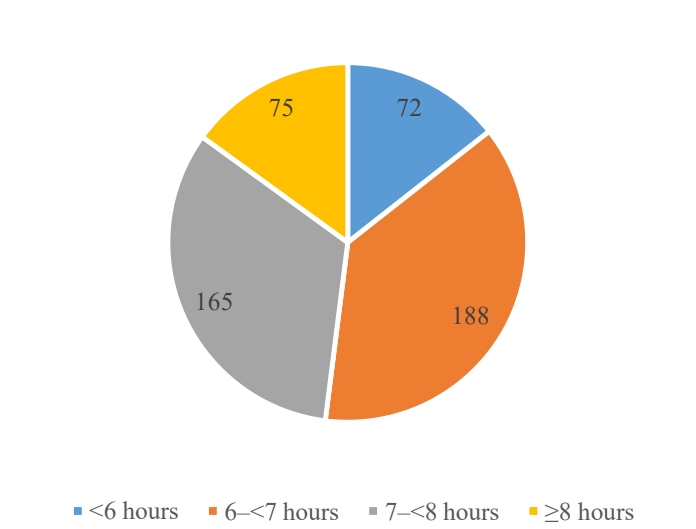
Results: The mean age of participants was 15.8 ± 1.2 years, and females comprised 54.0% of the sample. Mean school-night sleep duration was 6.8 ± 1.1 hours, compared with 8.5 ± 1.2 hours on weekends (p<0.001), while only 15.0% of students achieved ≥8 hours of sleep on school nights. Poor sleep quality (PSQI >5) was identified in 35.0% of participants. Technology exposure was substantial, with mean total screen time of 5.1 ± 1.9 hours/day and evening screen exposure after 9:00 pm of 2.5 ± 1.0 hours. Smartphone use within 30 minutes of sleep was reported by 68.8%, while 60.0% used smartphones in bed and 72.2% kept their smartphone beside the bed during sleep. Evening screen time was inversely correlated with sleep duration (r=−0.42, p<0.001) and positively correlated with PSQI score (r=0.39, p<0.001). In multivariable linear regression, evening screen time (β=−0.30, p<0.001), smartphone use in bed (β=−0.42, p=0.001), social media use (β=−0.14, p=0.006), late-night studying (β=−0.20, p=0.014), high academic workload (β=−0.25, p=0.025), and high perceived stress (β=−0.31, p=0.012) were independently associated with shorter sleep duration. In logistic regression, high perceived stress (AOR=2.42, 95% CI: 1.56–3.76, p<0.001) and evening screen exposure ≥2 hours (AOR=2.31, 95% CI: 1.51–3.53, p<0.001) were the strongest independent predictors of poor sleep quality. Smartphone use in bed, social media use, high academic workload, and evening caffeine consumption were also associated with increased odds of poor sleep quality, whereas regular physical activity was associated with lower odds (AOR=0.64, 95% CI: 0.41–0.99, p=0.046).
Conclusion: Insufficient sleep and poor sleep quality were common among secondary school students, with substantial differences between school-night and weekend sleep duration. Evening screen exposure, bedtime smartphone use, late-night studying, academic workload, and perceived stress emerged as important modifiable factors associated with adverse sleep outcomes. School- and family-based interventions promoting healthy sleep hygiene, limiting evening technology exposure, encouraging regular physical activity, managing academic workload, and addressing psychosocial stress may help improve adolescent sleep health.
References
Akçay, D., & Akçay, B. D. (2018). The influence of media on the sleep quality in adolescents. Turkish Journal of Pediatrics, 60, 255-263. PMID:30511537. https://pubmed.ncbi.nlm.nih.gov/30511537/
AlShareef S. M. (2022). The impact of bedtime technology use on sleep quality and excessive daytime sleepiness in adults. Sleep science (Sao Paulo, Brazil), 15(Spec 2), 318–327. https://doi.org/10.5935/1984-0063.20200128
American Academy of Pediatrics. (2014). School start times for adolescents. Pediatrics, 134(3), 642–649. https://doi.org/10.1542/peds.2014-1697
Bauducco, S., Flink, I. K., Jansson-Fröjmark, M., & Linton, S. J. (2020). Preventing sleep deficit in adolescents: Long-term effects of a quasi-experimental school-based intervention study. Journal of Sleep Research, 29(6), e12940. https://doi.org/10.1111/jsr.12940
Brautsch, L. A., Lund, L., Andersen, M. M., Jennum, P. J., Folker, A. P., & Andersen, S. (2023). Digital media use and sleep in late adolescence and young adulthood: A systematic review. Sleep medicine reviews, 68, 101742. https://doi.org/10.1016/j.smrv.2022.101742
CDC. (2024). About Sleep. CDC, May 15, 2024. https://www.cdc.gov/sleep/about/index.html
Chan, C. S., Poon, C. Y. S., Leung, J. C. Y., Lau, K. N. T., & Lau, E. Y. Y. (2018). Delayed school start time is associated with better sleep, daytime functioning, and life satisfaction in residential high-school students. Journal of Adolescence, 66, 49–54. https://doi.org/10.1016/j.adolescence.2018.05.002
Chang, A.-M., et al. (2015). Evening use of light-emitting eReaders negatively affects sleep, circadian timing, and next-morning alertness. Proceedings of the National Academy of Sciences, 112(4), 1232–1237. https://doi.org/10.1073/pnas.1418490112
de Sá, S., Baião, A., Marques, H., Marques, M. d. C., Reis, M. J., Dias, S., & Catarino, M. (2023). The influence of smartphones on adolescent sleep: A systematic literature review. Nursing Reports, 13(2), 612-621. https://doi.org/10.3390/nursrep13020054
Electronic Media Use and Sleep Disorders among Adolescents during the COVID-19 Pandemic. (2021). Sleep Disorders. Wiley. https://onlinelibrary.wiley.com/doi/10.1155/2021/2096944
Fobian, A. D., Avis, K., & Schwebel, D. C. (2016). The impact of media use on adolescent sleep efficiency. Journal of Developmental & Behavioral Pediatrics, 37(1), 9-14. https://doi.org/10.1097/DBP.0000000000000239
Koreti, S., & Eske, G. S., Saxena, S. (2017). Impact of media on sleep quality of adolescents. Pediatric Review: International Journal of Pediatric Research. DOI: https://doi.org/10.17511/ijpr.2017.i12.04
Lund L, Sølvhøj IN, Danielsen D, Andersen S. Electronic media use and sleep in children and adolescents in western countries: a systematic review. BMC public health. 2021 Sep 30;21(1):1598. https://link.springer.com/article/10.1186/s12889-021-11640-9
Mehta, K. J. (2022). Effect of sleep and mood on academic performance—at interface of physiology, psychology, and education. Humanities and Social Sciences Communications, 9(1), 16. https://www.nature.com/articles/s41599-021-01031-1
Ming, X., Koransky, R., Kang, V., Buchman, S., Sarris, C. E., & Wagner, G. C. (2011). Sleep Insufficiency, Sleep Health Problems and Performance in High School Students. Clinical Medicine Insights: Circulatory, Respiratory and Pulmonary Medicine, 5, 71–79. DOI: 10.4137/CCRPM.S7955
Okano, K., Jha, A., Tyler, L., Garica, J., & Czeisler, C. A. (2019). Sleep quality, duration, and consistency are associated with better academic performance in college students. npj Science of Learning, 4, 16. https://doi.org/10.1038/s41539-019-0055-z
Pérez-Chada, M., Pérez-Lloret, S., Videla, A. J., O'Flaherty, M., & Cardinali, D. P. (2023). Screen use, sleep duration, daytime somnolence, and academic failure in school-aged adolescents. PLoS ONE, 18(1), e0281379. https://doi.org/10.1371/journal.pone.0281379
Singh, R., Roy, M. M., Chouhan, S., Joshi, A., & Rai, N. K. (2023). Impact of school start time and sleep pattern of adolescents on their mood and sleep quality. Journal of family medicine and primary care, 12(10), 2469–2475. https://doi.org/10.4103/jfmpc.jfmpc_803_23
Swope, C. B., Rong, S., Campanella, C., Vaicekonyte, R., Phillips, A. J. K., Cain, S. W., McGlashan, E. M. (2023). Factors associated with variability in the melatonin suppression response to light: A narrative review.
The association of smartphone screen time with sleep problems among adolescents and young adults: cross-sectional findings from India. (2022). PubMed article. https://pubmed.ncbi.nlm.nih.gov/36064373/
URL: https://pubmed.ncbi.nlm.nih.gov/22084618/
Wang, H., & Fan, X. (2023). Academic Stress and Sleep Quality among Chinese Adolescents: Chain Mediating Effects of Anxiety and School Burnout. International journal of environmental research and public health, 20(3), 2219. https://doi.org/10.3390/ijerph20032219
West, K. E., Jablonski, M. R., Warfield, B., Cecil, K. S., James, M., Ayers, M. A., Maida, J., Bowen, C., Sliney, D. H., Rollag, M. D., Hanifin, J. P., & Brainard, G. C. (2011). Blue light from light-emitting diodes elicits a dose-dependent suppression of melatonin in humans. Journal of Applied Physiology, 110(3), 619-626. https://doi.org/10.1152/japplphysiol.01413.2009
Yip, T., et al. (2022). School start times, sleep, and youth outcomes: A meta-analysis. Sleep Health, 8(6), 611–623.
Zacharia, G., Sreenivasan, P., Iyer, G. S. I., Reghunath, A., & Shajahan, M. R. (2022). Sleep deprivation among school-going adolescents in an urban setting in Kerala, India: A descriptive study. Journal of Health Management, 24(3), 412–421. https://doi.org/10.1177/09731342221122841
Downloads
Published
Issue
Section
License
Copyright (c) 2025 Authors

This work is licensed under a Creative Commons Attribution-NonCommercial 4.0 International License.